
From design to content, or rather backwards?
During the last few years, during my work in an agency, I noticed a pattern that repeated itself on almost every project. A client comes in. The brief is about a new website. The conversation quickly moves to layout, colors and typography. Somebody asks about the logo. Nobody asks about the content. At some point (usually late in the process) a document arrives. The design is already done. Now the content has to fit.
It rarely does. Pages get restructured. Sections get cut. The carefully designed hero area turns out to need three times more text than planned. The result is a compromise, a design that doesn’t quite serve the content, and content that doesn’t quite fit the design.
I didn’t have a name for this problem at the time. It was during my master’s (especially during the class of user experience design) when I realized this was something I could connect to a broader concept.
Built for lorem ipsum
Building structure and layout before knowing what goes inside is often the order of the whole process. The design becomes the container, and content is expected to fill it – lorem ipsum holding the place until the real words arrive.
That gets the relationship backwards. Users don’t come to a website for the layout. They come for the content. Jesse James Garrett (2011) describes five planes of UX in The Elements of User Experience. From abstract to concrete: strategy, scope, structure, skeleton and surface. Content belongs to the scope plane (the second layer from the bottom), visual design sits at the surface (the topmost layer). Working top-down means content shapes design.
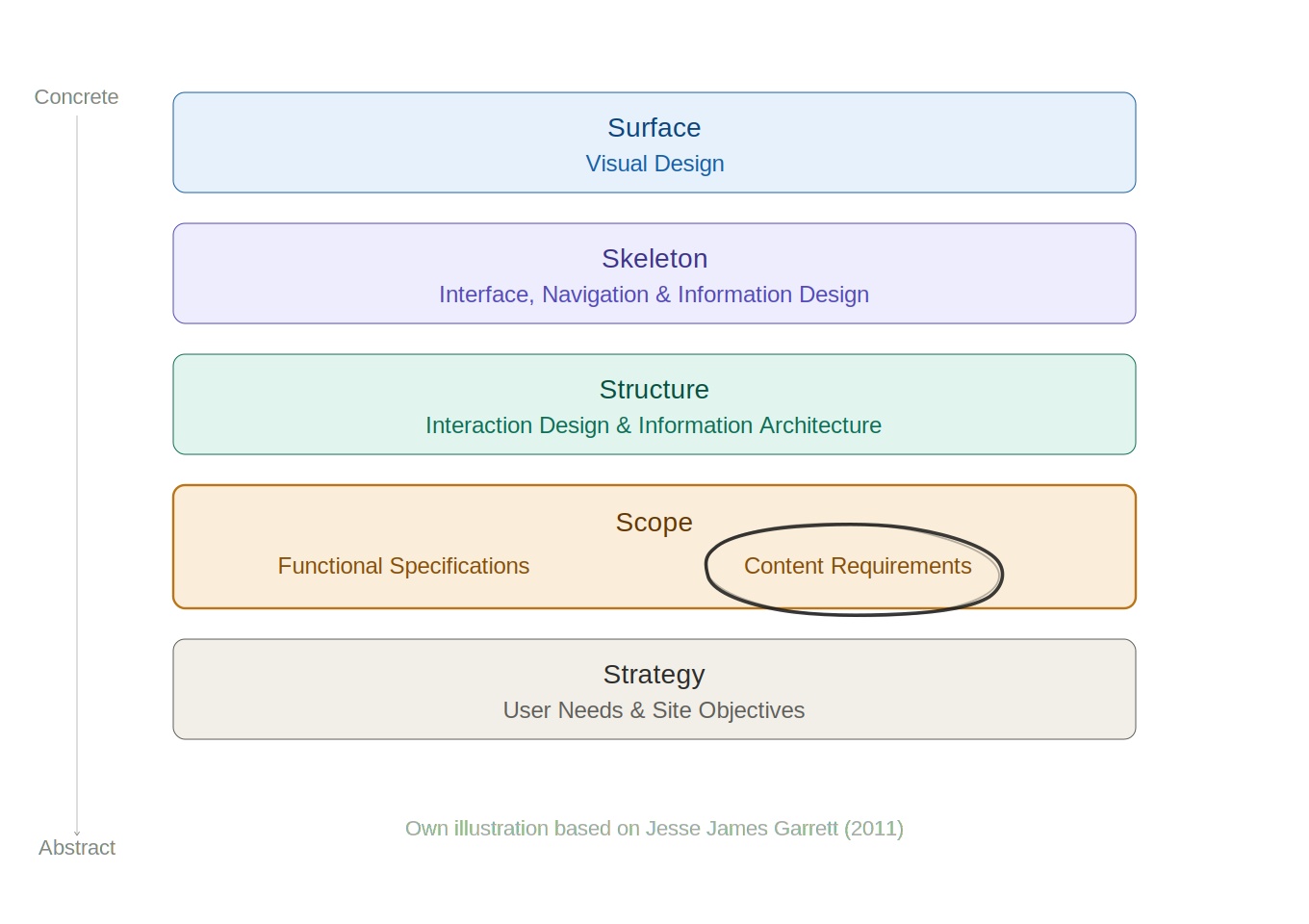
A content-first approach means understanding what an organization needs to communicate before deciding how it should look. Not every word written before opening a design tool, but content decisions made early enough to shape the design, not be squeezed into it afterwards.
This is where content strategy comes in. It provides frameworks and tools for exactly this, figuring out what needs to be communicated, structuring it and creating a foundation before the next steps begin.
The real challenge
Knowing all of this doesn’t make it easy to execute. In my experience, the hardest part isn’t the concept, it’s getting clients there with you.
Content work requires something from clients that design work often doesn’t: active participation. They need to make decisions about what they want to say, gather existing materials, write or approve copy. Clients engage more when they understand why their input shapes the outcome. What I’ve found helpful is framing. Not “we need your content” but “what you want to say is what shapes what we build.” That shift from content as a deliverable to content as a starting point changes how the whole process feels.
“[…] it’s impossible to design a good user experience with bad content.” (Halvorson & Rach, 2012, p. 193)
It’s still one of the harder parts of the work. But it’s also where content strategy and project management come together.

Sources:
- Garrett, J. J. (2011). The Elements of User Experience: User-centered Design for the Web and Beyond. New Riders.
- Halvorson, K., & Rach, M. (2012). Content Strategy for the Web (2nd ed.). New Riders.